

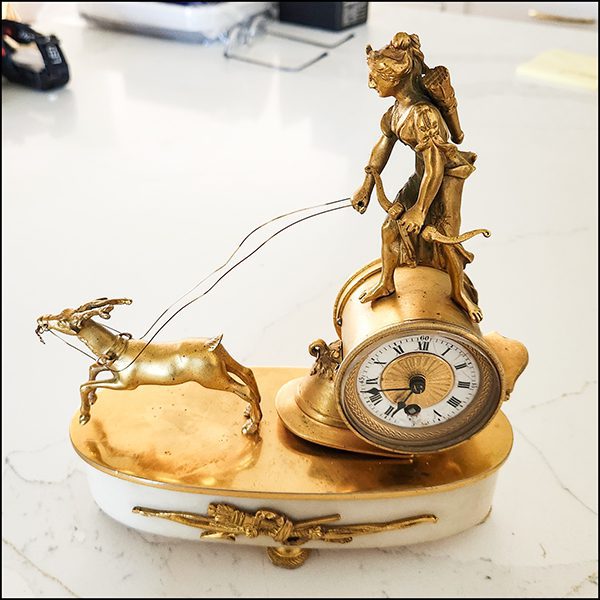
You thought you had it all figured out. A clock goes on a mantel. Or maybe a shelf. Possibly a sideboard if you’re feeling daring. The furniture has spoken, the clock obeys, and harmony reigns. And then along comes the table clock, quietly clearing its throat, tapping its tiny feet, and asking a very inconvenient question: “Why am I being pigeonholed?”
Yes, the table clock exists, has existed for centuries, and has been politely waiting while we lumped it in with everything from mantelpieces to mystery furniture surfaces. The truth is, the phrase table clock isn’t some modern marketing flourish. It’s an old, proper term that has been misunderstood, misused, and mildly offended for generations.
Let’s set the record straight, preferably on a sturdy table.
FOR A TABLE CLOCK A TABLE ISN’T JUST A TABLE
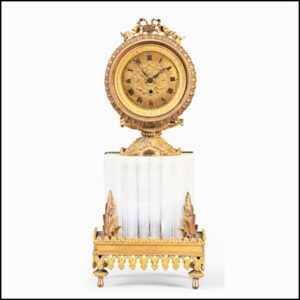
The idea behind a table clock was never about a specific piece of furniture. Historically, “table” referred to a flat surface intended for practical daily use. That surface could be a side table, a writing desk, a library table, or something grand enough to make your elbows feel underdressed. The table clock was designed to live where life happened.
This is why collectors sometimes raise an eyebrow when someone insists a clock must live on a mantel. Many early clocks weren’t designed for mantels at all. Some predate widespread fireplace mantels entirely. The table clock was meant to be portable, visible, and useful, without being nailed to architecture or locked into one room.
Which explains why so many old mantelpiece clocks are, structurally speaking, table clocks in disguise. They simply got comfortable where they landed.
THE MANTEL CLOCK MYTH AND OTHER TABLE CLOCK CONFUSIONS
Somewhere along the line, the mantel became clock royalty. It was elevated, central, and dramatic. Naturally, clocks followed. But this led to the unfortunate belief that anything rectangular with a dial must be a mantel clock.
Enter the old mantle clock, a term that sounds specific but is often used loosely. Many so-called mantle clocks were originally marketed and sold as table clock models. They were sized for desks, consoles, and yes, tables. The mantel was just one possible destination, not a mandatory residence.
This overlap is why antique listings can feel like a linguistic obstacle course. One person’s table clock is another person’s mantelpiece treasure, and both may be technically correct.
THE PORTABILITY ADVANTAGE OF A TABLE CLOCK
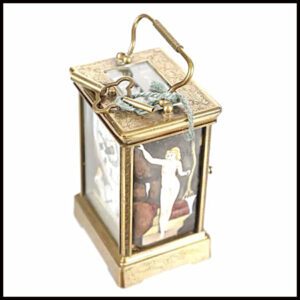
One of the defining charms of the table clock is its freedom. Unlike wall clocks, it doesn’t demand installation. Unlike longcase clocks, it doesn’t claim square footage like a territorial cat. You can move a table clock from room to room, season to season, mood to mood.
That portability made it wildly popular in the 18th and 19th centuries, especially among households that valued flexibility and function. It also explains why many vintage clock designs emphasize balance, proportion, and decorative sides. These clocks were meant to be admired from multiple angles, not trapped against a wall.
A table clock knows it might be relocated. It dresses accordingly.
WHY COLLECTORS LOVE TABLE CLOCKS
Collectors are drawn to them for several reasons. First, the variety is staggering. Case shapes range from austere to flamboyant. Dials can be restrained or theatrical. Movements span centuries of innovation. Second, condition tends to be better. Because table clock examples were often kept indoors, moved carefully, and not exposed to soot or heat like mantel clocks, many survive in excellent form.
It also helps that old mantelpiece clocks and table clocks often share construction methods, making the learning curve gentler for new collectors. Once you understand one, the other starts whispering secrets.
And let’s be honest. There’s something deeply satisfying about owning a clock that refuses to be bossed around by furniture labels.
THE MODERN MISUNDERSTANDING
Today, table clocks are having a quiet renaissance. Interior designers love them because they break rules without breaking rooms. A vintage clock on a modern desk adds instant gravity. A classic clock on a kitchen island sparks conversation. People stop asking where the clock “belongs” and start asking where it looks best.
Which is exactly how it was always meant to be.
Meanwhile, terms like old mantle clock persist, sometimes accurately, sometimes not. Language evolves, categories blur, and clocks continue ticking without concern for our naming conventions.
SO WHAT DO YOU CALL IT?
Call it a table clock if it was designed to sit freely on a surface and be moved as needed. Call it an old mantle clock if history, tradition, or habit insists. Call it one of the many old mantelpiece clocks if you enjoy a bit of poetic overlap. Just know that beneath the label, the clock itself doesn’t mind.
It’s been waiting patiently for decades, sometimes centuries, for us to catch up.
And if you happen to be looking for particularly handsome table clocks, well, there are always a few quietly available, ready to take their place on whatever surface you deem worthy.
Antique Clock Dealers Where You Can Locate Your Treasure
